
For Jeff Allred, what started as a beautiful Tuesday morning on September 11th ended in a church service, praying and reflecting with his community about the tragedy that had just occurred on their country’s soil. Allred lived in Atlanta, Georgia, working as the President of Premiere Global Services, a multinational technology company. He was responsible for thousands of employees across the nation and countless other clients. His company had locations in major cities such as New York and Washington, D.C., where many workers were stationed. Through the experiences of himself, his co-workers, his employees, and his clients, Jeff Allred provides a unique perspective on the events of 9/11 and the nature of the day itself. However, for Allred, he admits that his biases have impacted the way he has since viewed the government’s response to the attacks, including his disapproval of Vice President Dick Cheney and the way he went about bringing the United States to war in Iraq.
On the morning of September 11th, Jeff Allred and his wife started discussions surrounding landscaping plans for the front yard of their new home. In the kitchen, with the TV running, a news flash appeared showing a plane that had crashed into the North Tower of the World Trade Center. He immediately assumed it was a small plane that had veered off course. “There were often sightseeing planes going over the Hudson River,” Allred said. “I thought one of them had lost track of where they were going and accidentally crashed into the Trade Center.” It was at 9:03 A.M. when it became apparent to him that America was under attack, as a second plane crashed into the South Tower. He immediately dropped what he was doing and realized he had to check in on his clients and employees. He hopped into his car and drove to his office, starting to man the phones and account for his people once he was there. While it turned out that none of the members of his team were in the Towers, a client of his company (Cantor Fitzgerald) lost over 600 employees who were present in the offices of the upper floors of the North Tower. It did not take long for the government to shut down the airways, leaving countless stuck in traffic on the roads. As Allred recalls, the entire nation seemingly came to a screeching halt.
The immediate reaction to the four airplane hijackings was a sense of shock. A shock about both the simplicity and the horror of the mass attack. “The attack on our country involved nothing but box cutters,” Allred said. “It took only a few trained men with box cutters to weaponize four planes and to leave thousands of people dead.” The attack on 9/11 was the first major attack on mainland U.S. soil in a long time. It took away a feeling of invulnerability that American citizens had. Immediate reactions of anger and confusion quickly rose. The country also became united in response to the attacks. Allred noted that months after the hijackings, many houses had American flags flying on their front porch. Political divide was put aside to defeat a common enemy. For some time after 9/11, nobody was a Republican or a Democrat; rather, they were all Americans.
The nation tightened its defenses and airports ramped up security screenings after the attacks on our country. There was a broad call for justice against the perpetrators of 9/11, as fear grew of those responsible for the attacks and their potential development of weapons of mass destruction. Americans sacrificed their freedom to guarantee their safety against future strikes. Allred noted how the standard for a search and seizure procedure lowered significantly, and the government dropped privacy protections in favor of espionage and investigation. “The government pushed the limit of what was constitutional after the attacks,” he said. “What was due process, what was a war crime, what was not a war crime. Everything got tested to its limits.” Over the following months and years after 9/11, the erosion of personal freedoms allowed for a more direct response against the enemy. While there was original support for a war on terror, many, including Allred, later became skeptical regarding the nature of the war.
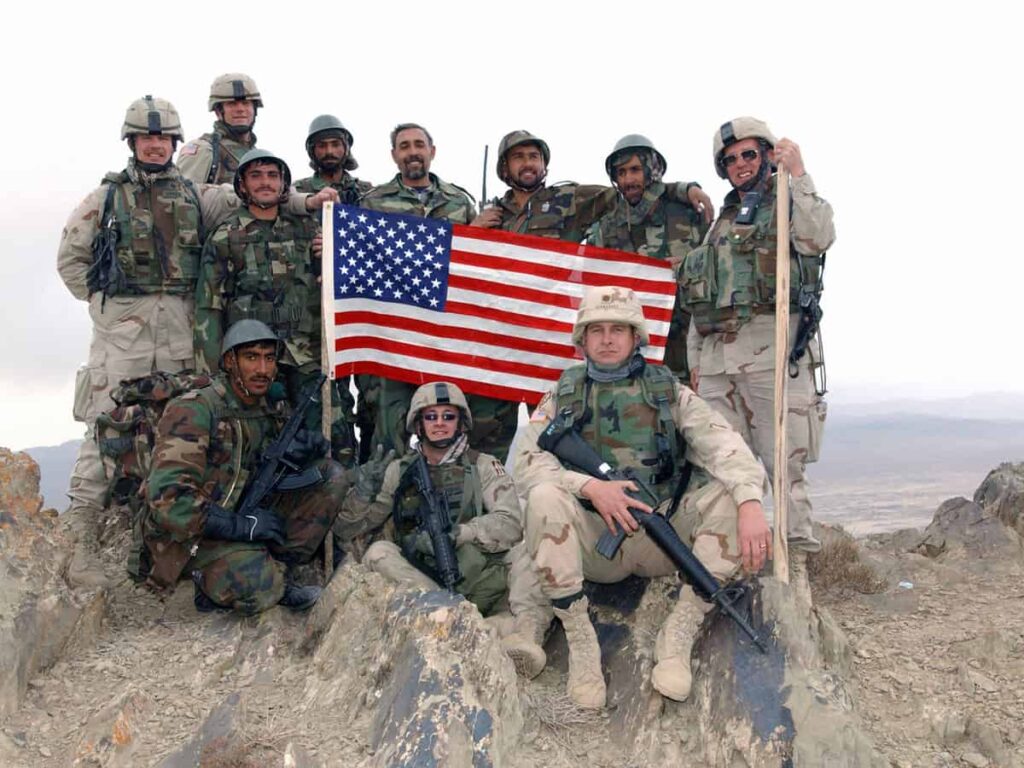
Allred initially felt that the government did what it had to do in a time of war, which was using the superior military and financial power of the United States to attack the enemy. However, he later began to feel as if many of the wars fought in the name of terror were not justified, especially the 2003 invasion of Iraq. He recalled that former President George H. Bush’s administration was criticized for not previously taking Saddam Hussein prisoner in Iraq during the response to Hussein’s invasion of Bahrain in 1991. Allred felt that the U.S. government, specifically Vice President Dick Cheney, used the 9/11 attacks as an excuse to settle the score in Iraq with Saddam Hussein. He perceived Cheney to be very “hawkish” when trying to bring the fight to Iraq for allegedly harboring terrorists. Allred noted that the war in Iraq was based on the premise that weapons of mass destruction were being developed there, but in fact, none were ever found. In Afghanistan, the US invaded to take down the Taliban, an Islamic and jihadist militant group that had clearly supported al-Qaeda. Their response was a “brunt, expensive, and long military campaign in response to a non-military enemy,” Allred said. Over time, support waned for the war in Afghanistan as costs rose and the years went on with U.S. troops still stationed there. People became tired of war, questioning our ability to stabilize a fractured country, even after taking control of it militarily.
Allred’s concerns about the methods surrounding the war on terror can be traced back to his own biases. In the 2000 Presidential Election, he voted for Al Gore and he was not a big fan of George W. Bush. He was particularly uneasy about his Vice-Presidential candidate Dick Cheney and his political agenda. Despite his anger toward the enemy, Allred remained concerned about the breadth of the U.S. military response and the cost it would bring. While he supported the defense of the United States, he was against mass invasion and war. Cheney’s manipulation of the evidence involving Iraq’s support of terrorism got the U.S. to intervene there, and this angered Allred. As a pro-individual liberty person, he feels as if people shouldn’t use crises to take away these personal liberties. He also realizes that, while people can be compelled for the common good, it should only be to the necessary extent. It was in this sense that Allred believes the United States paid an unnecessarily high price in its war on terror.
The attacks on our country on September 11th, 2001, forever changed our country and the world as we know it. Those who experienced the attacks on that fateful Tuesday morning and live to tell the tale recall how the scale and threat of terrorism became a lot more frightening after 9/11. Many Americans became paranoid at any sense of alarm, immediately assuming that it was a form of terrorism. The landscape of our nation since that day would be unrecognizable to someone back then. From tighter security in airports to changed views on war and Islam, the impact of 9/11 is undeniable and is still felt today. With the U.S. government intervening in costly and later unpopular wars after the attacks, it fed the narrative of those seeking a pan-Islamic caliphate with America as the enemy of Islam. “Bin Laden got what he wanted,” Allred said. “America no longer retains the same sense of safety it once had.” For Jeff Allred, the impact of that fateful morning has been everlasting.